The secret behind strong nails — and no, it's not calcium!
- Sandra Luz
- Mar 20
- 2 min read
Updated: Mar 23
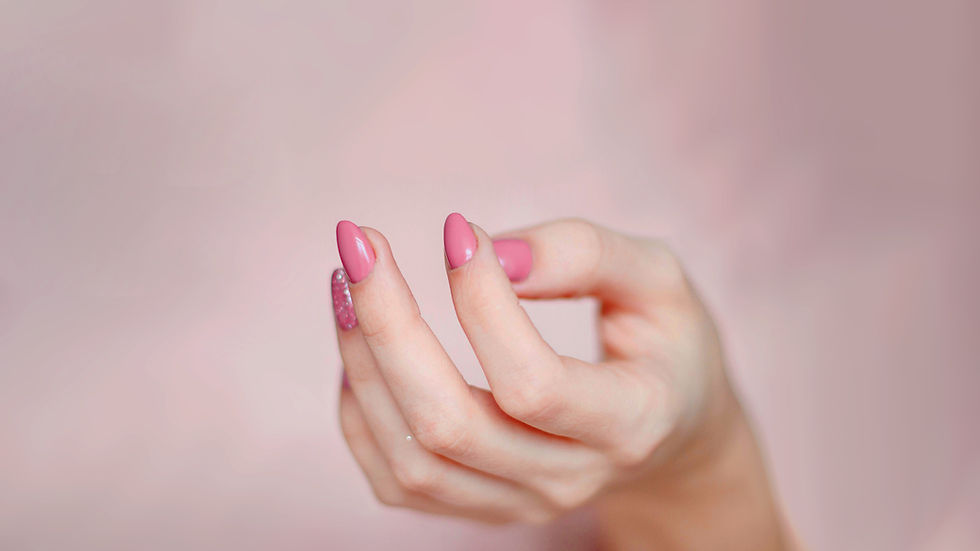
We are not all the same — and aren't we glad! It's this diversity and variety that makes us unique. The same goes for our hands and, more specifically, our nails. There's something for everyone! Wide, narrow, long or short, strong, sensitive, brittle or fragile. A genetic lottery, where age, diet and lifestyle also get a say.
So who's really responsible for how strong our nails are? Is it calcium, like I've heard so many times? The answer is NO!
So let's set the record straight. To make sense of what I'm about to explain, let me start with a quick overview of what a nail actually is, how it forms and what it's made of — sounds good?
FACTS
The nail is a cutaneous appendage — a structure similar to skin but with its own unique characteristics.
Its job is to protect the fingertip and help with tactile sensitivity — basically, how we feel things.
The nail forms in the matrix.
The matrix sits beneath the fold of skin at the base of the nail. That little half-moon shape you can see — the lunula — is actually the visible part of the matrix.
Nails are mostly made up of proteins, with keratin being the star of the show.
Alongside keratin, nails also contain cysteine, sulphur, water, lipids, zinc, magnesium, sodium, iron and calcium — though calcium only makes up a tiny 0.01% or so.
The water content in nails is significantly higher than the lipid content — and it varies from person to perso
As for their composition in terms of water and lipids, the values can vary slightly depending on factors such as nail health and care. It is worth noting that the percentage of water in nails is significantly higher than that of lipids — between 3.5 to 7 times more — and varies from person to person.
So, what makes nails strong?
Sulphur! It's the secret ingredient that creates connection points within the keratin, giving nails their rigidity and resilience.
Still with me? Let's break it down even further!
Keratin is a protein packed with amino acids. One of these amino acids is cysteine — and cysteine contains sulphur.
Cysteine carries a chemical group called thiol (-SH), made up of sulphur and hydrogen.
When two thiol groups meet, they react and form a bridge linking them together — this is what we call a disulfide bond. Think of a zip: every tooth that locks into another helps hold everything firmly in place. In nails, each disulfide bond is one of those teeth, locking the keratin chains together. The more bonds there are, the stronger and more rigid the nail becomes.
Until next time!
If you enjoyed this, don't forget to follow, like and share.
XOXO
Kiss on the forehead
SaL


Comments